
Air source heat pumps: the complete homeowner buying guide

An air-source heat pump collects heat from outdoor air and uses electricity to raise it to a useful temperature. For a homeowner, the important choice is the complete heating arrangement: how it warms each room, supplies hot water and fits the property.
This buying guide explains what to establish before requesting quotations, what a proper survey should answer and how to compare practical options.
Reviewed 29 October 2026.
Air-to-water or air-to-air?
Type | How rooms are heated | Hot-water question |
|---|---|---|
Air-to-water | Water circulates through compatible radiators, underfloor heating or other emitters | Often supplies a domestic cylinder or another designed storage arrangement |
Air-to-air | Indoor fan units or a designed duct system deliver conditioned air | Usually needs a separate solution, although combined products exist |
Both collect outdoor heat, but the installation and everyday experience differ. An air-to-air quote for one living room is not equivalent to an air-to-water system designed to cover the whole home and its hot water.
Read our air-to-air guide if you are considering individual indoor units. This guide concentrates on the buying decisions around an air-to-water conversion from boiler-based heating.
Will an air-source heat pump work in your home?
Start with the heat the building loses and the temperatures you need, not simply bedroom count or construction age. A room-by-room assessment should establish the heating requirement and how the proposed emitters meet it.
The system also needs a suitable outdoor location, practical pipe routes, electrical provision and hot-water arrangements. Permissions, maintenance access and neighbouring properties can influence the options even where the heating calculation looks straightforward.
Energy Systems Catapult's demonstration project found successful installations across the property types tested. That supports investigating varied homes without treating the result as approval for every individual property. Read the project reports.
What should the survey cover?
Survey topic | Useful outcome |
|---|---|
Building and rooms | Heat-loss assumptions, intended temperatures and cold-weather design conditions |
Existing emitters | Which stay, which change and their output at proposed water temperatures |
Distribution | Pipe routes, required flow and any justified replacement |
Hot water | Household demand, storage location and recovery arrangements |
Outdoor equipment | Location, airflow, noise assessment, drainage and access |
Electricity | Required circuit, protection and any supply checks |
Controls | Normal schedule, compensation and user operation |
Work scope | Removal, making good, commissioning and aftercare |
Tell the surveyor about rooms currently kept cold, planned extensions and changes in occupancy. Otherwise the design may reproduce your old level of heating instead of the comfort you expect from the new system.
Ask what is known and what remains uncertain behind finished surfaces. A survey cannot reveal everything, but a good quotation makes its assumptions and variation process clear.
Choosing the heat-pump size
The proposed model should meet the assessed requirement under the relevant outdoor and water conditions. Its nominal capacity is not the same as its output under all conditions, so request the applicable performance data.
Also ask what happens in milder weather. A system needs appropriate control and operation when demand is far below the cold-weather maximum. Buying the largest available model is not a replacement for that assessment.
Our sizing guide explains the design information to request. Energy Saving Trust's heat-loss toolkit provides the technical context.
Do you need new radiators or underfloor heating?
Some installations retain existing radiators; others change selected emitters. Each room's required output should be compared with what the radiator delivers at the proposed temperatures. Underfloor heating is one possible solution, not a universal condition.
Ask for a room-by-room schedule and the cost of each alteration. Check wall space, furniture and decoration as well as the emitter's output. Do not reject useful upgrades solely to reduce the headline quotation, or accept a complete replacement package without an explanation.
Pipework also needs assessment. Narrow pipes are not automatically unsuitable, but the distribution must carry the required flow acceptably. Read the microbore design guidance before treating diameter alone as a verdict.
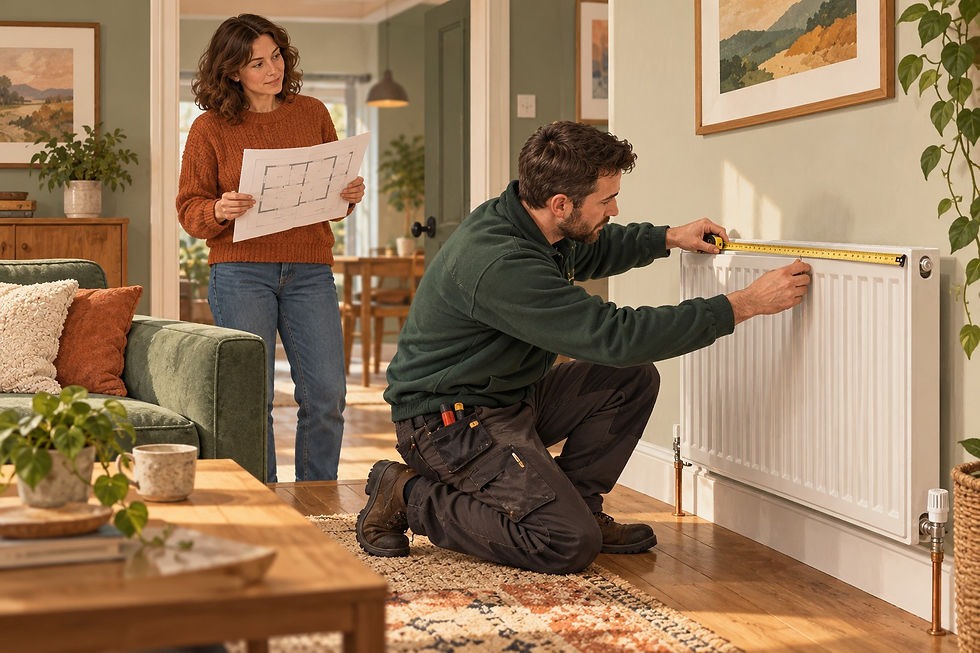
Illustrative image. The equipment and layout for a particular home must be assessed as part of its design.
What happens to your hot water?
Moving from a combi boiler often means accommodating storage. Ask for the actual equipment dimensions, service access, structural or cupboard alterations and pipe routes. An appliance fitting into a cupboard does not establish that it can be maintained there.
Describe baths, showers and consecutive use. Ask the designer to explain usable supply, recovery and any electric backup. The cylinder's nominal capacity alone does not answer whether the arrangement suits your household.
If an alternative storage technology is proposed, establish compatibility, capacity, running cost, warranty and grant eligibility. Our hot-water guide covers the practical comparison.
Where can the outdoor unit go?
The unit needs suitable airflow, structural support, drainage and maintenance access. Its location also affects pipe routes, noise and the appearance of the property. Avoid choosing solely on where the box is least visible.
Ask for a drawing with the manufacturer's clearances and the relevant acoustic assessment. Nearby windows, reflecting surfaces and vibration transmission may matter. A low brochure sound figure cannot establish acceptability at a particular boundary or bedroom.
Planning requirements vary across the UK and with the installation. Lease or freeholder consent, listed-building issues and building regulations are separate questions. Get the relevant answers before accepting a location dependent on uncertain consent.
Installation costs and funding
Request the complete surveyed price: equipment, emitters, cylinder where required, pipework, wiring, base, drainage, removal, commissioning and making good. Separate exclusions so quotations can be compared fairly.
Published benchmarks are useful context, but your contribution depends on the work and confirmed support. Check the official Boiler Upgrade Scheme guidance for England and Wales and the separate arrangements for your nation. Do not assume a supplier's starting price applies to your home.
Our installation cost guide explains budgets and grant deductions. Keep repayable finance separate from grants, and check who bears the cost if support is not approved.
Will it reduce your bills?
Calculate useful annual heat divided by seasonal system efficiency, multiplied by the electricity price paid. Compare that with the cost of supplying the same heat through your current system. Include relevant electrical inputs and separate standing charges and servicing.
For illustration, 12,000kWh of useful heat at seasonal efficiency 3.0 needs 4,000kWh of electricity. At an assumed 25p/kWh, that is £1,000 of heating energy. The same heat at efficiency 4.0 costs £750. These are original examples, not typical-house promises.
Tariff choice can change the result, but assess all household electricity and actual timing. A cheap overnight rate cannot be applied to every unit consumed during the day. Compare cautious and optimistic cases rather than relying on a single saving forecast.
What is it like to use?
The intended strategy may involve longer operation and lower water temperatures than your boiler. That does not mean every room must feel cooler or every system must follow one universal schedule.
Ask for a demonstration of room-temperature settings, hot-water schedules, holiday mode, normal defrost behaviour and any backup heating. Weather compensation should be explained in plain language, with the commissioned settings recorded.
Do not disable safety or frost-protection functions to reduce apparent consumption. If performance is disappointing, record the symptoms and ask for comparison with the design rather than making several untracked changes.
Choosing an installer and aftercare
Check relevant certification, insurance and experience with your proposed type of system. Ask to see a complete sample design and the handover documents you will receive, rather than relying solely on badges or review scores.
Get the service price, warranty obligations and repair route in writing. Remote diagnostics can be useful, but establish who attends when physical work is necessary and which components are covered.
Government installer guidance sets out useful questions. Our installer comparison guide helps turn the answers into a practical shortlist.
Air-source heat pump FAQs
Do they work in freezing weather?
Appropriately selected systems can operate in cold weather. The question is whether the exact design supplies your required output under those conditions, not simply whether the compressor can run.
Is steam from the outdoor unit a fault?
Vapour can occur during normal defrost. Persistent ice, repeated faults or loss of heating needs investigation. Follow the owner's instructions and contact the installer rather than attacking ice or opening the unit.
Can an air-source heat pump cool the house?
Some systems can, but cooling needs a compatible design and condensation control. Ordinary radiators should not be assumed to provide useful safe cooling.
How long does installation take?
It depends on the full work scope. Get a project timetable including survey, permissions, enabling work, equipment fitting, commissioning and the period without heating or hot water.
Is a heat pump worth buying now?
Compare today's confirmed costs and practical options with the condition of your current system. Our worth-it guide helps separate timing, comfort and financial questions.
Related guides for your next step
To compare equipment across manufacturers, use our air source heat pump comparison alongside your property-specific design.
To plan access, disruption and handover, follow the heat pump installation process.
For the room-by-room emitter checks, read our guide to radiators for heat pumps.
Before agreeing the equipment location, check heat pump planning permission by UK nation.
Sources and scope
This guide draws on the linked government, Energy Saving Trust and demonstration-project material. Numerical examples are original arithmetic with stated assumptions. It is not a report of a system we have tested or a substitute for a property survey.

Comments