
How much does a heat pump cost in the UK?

Updated: May 26, 2025
An air-source heat pump costs around £12,000 to install, according to the Energy Saving Trust's current guide. If you qualify for the standard £7,500 Boiler Upgrade Scheme grant in England or Wales, that would leave about £4,500 to pay. Your actual quote could be substantially lower or higher, depending on the work your home needs. [1]
The outdoor unit is only part of the price. A complete installation may also involve a hot-water cylinder, radiator changes, electrical work and alterations to pipework. Comparing the price of the heat pump itself with a fully fitted system can therefore be misleading.
This guide explains what a heat pump installation should include, how grants affect the amount you pay, which extras to check and how to compare the longer-term costs with keeping or replacing your boiler.
Funding and VAT provisions rechecked 29 October 2026; cost research prepared 27 October 2026. Published cost benchmarks, supplier examples and our illustrative calculations are identified separately. Grants depend on eligibility and availability.
Heat pump costs at a glance
For most readers replacing a boiler, the relevant starting point is an air-to-water heat pump. This heats water for radiators or underfloor heating and usually supplies a domestic hot-water cylinder.
Cost or funding item | Amount | How to interpret it |
|---|---|---|
Air-source heat pump installation | Around £12,000 | Energy Saving Trust benchmark before a grant; not a quotation for your home |
Standard Boiler Upgrade Scheme grant | £7,500 | Eligible air-to-water and ground-source installations in England and Wales |
Illustrative amount left from a £12,000 installation | £4,500 | £12,000 minus £7,500; assumes the full installation is covered by that quote |
Temporary uplifted grant | £9,000 | Eligible oil or LPG replacement, with no mains gas connection, until 31 March 2027 |
Illustrative amount left with that uplift | £3,000 | £12,000 minus £9,000; eligibility must be confirmed |
Routine servicing | Around £150 a year | Energy Saving Trust guide figure; obtain a price for your model and location |
Sources: Energy Saving Trust and GOV.UK. [1–3]
Keep three figures separate when you request prices: the full installed cost, the confirmed grant and the final customer contribution. A headline price that already includes funding should not have the grant deducted a second time.
How much does each type of heat pump cost?
Air-to-water heat pump installation costs
The Energy Saving Trust's approximately £12,000 benchmark is a useful starting point. It is not a price ceiling, and the work included in an individual quote still needs checking. [1]
A straightforward installation can cost less than a complicated conversion. Short pipe routes, suitable existing radiators, straightforward electrical provision and an accessible cylinder location all help. A larger heating requirement, awkward access or substantial changes inside the house can increase the total.
Instead of choosing a system purely by bedroom count, ask for a survey and a room-by-room heat-loss calculation. Two three-bedroom houses can need quite different heating systems.
Ground-source heat pump installation costs
Ground-source systems add a buried collector or boreholes to the project. The Energy Saving Trust gives around £15,000 as a benchmark for a system with a collector in trenches, while warning that boreholes cost considerably more. [4]
That figure should not be treated as a reliable budget for every existing house. To illustrate the variation, installer R A Brown publishes an example for a four-bedroom property with 12 radiators at £32,000–£35,000 with a horizontal collector, or £50,000–£55,000 with boreholes. These are that installer's example prices, not national averages. [5]
Ask whether ground investigations, drilling, collector pipework, manifolds, spoil removal and reinstating the garden are included. A quote for the indoor heat pump alone does not answer the cost of the complete ground-source installation.
Air-to-air heat pump costs
Air-to-air systems supply warm air through indoor units rather than heating water for radiators. Many also provide cooling. Energy Saving Trust research gives examples of around £1,900 for a single room and £3,700 for a three-bedroom semi-detached house, with possible additional costs such as redecoration. [6]
These are not directly interchangeable with a whole-house air-to-water installation: the rooms served, indoor-unit arrangement and hot-water provision matter. Ask how bathrooms, closed bedrooms and domestic hot water will be covered.
GOV.UK lists a £2,500 Boiler Upgrade Scheme category for eligible air-to-air installations. However, when checked on 29 October 2026, Energy Saving Trust still described rollout and installer-certification requirements as pending. Do not deduct the grant until your installer confirms that the application route is open for your installation and all requirements can be met. A single-room heating-and-cooling unit should not be assumed eligible. [2,6]
What should a heat pump installation quote include?
A useful quotation describes a working heating and hot-water system, with its assumptions and exclusions. It should tell you what will be installed and how the installer expects it to meet your needs.
Item | What to check in the quotation |
|---|---|
Survey and design | Room-by-room heat loss, intended room temperatures and design conditions |
Heat pump | Exact make, model and proposed capacity |
Outdoor installation | Base or brackets, vibration isolation, clearances and drainage |
Hot water | Cylinder model, capacity, location and associated controls, where required |
Radiators or underfloor heating | Which emitters stay, which change and their intended output |
Pipework | Routes, insulation and any replacement or enlargement |
Electrical work | Supply circuit, protection, isolation and any separately charged upgrades |
Controls | Thermostat, weather compensation, zoning and any connectivity charges |
Removal | Boiler, redundant equipment and waste disposal |
Commissioning | Testing, balancing, settings, certification and owner handover |
Funding and tax | Gross price, grant deduction, VAT treatment and final amount payable |
Aftercare | Warranty, service obligations, fault support and responsibility for performance problems |
Ask whether the price is a fixed post-survey quotation or an initial estimate. If extra work is discovered, agree how it will be priced and approved before it happens.
A low headline price can still be good value. The problem is an incomplete scope that makes two apparently comparable offers cover different jobs.
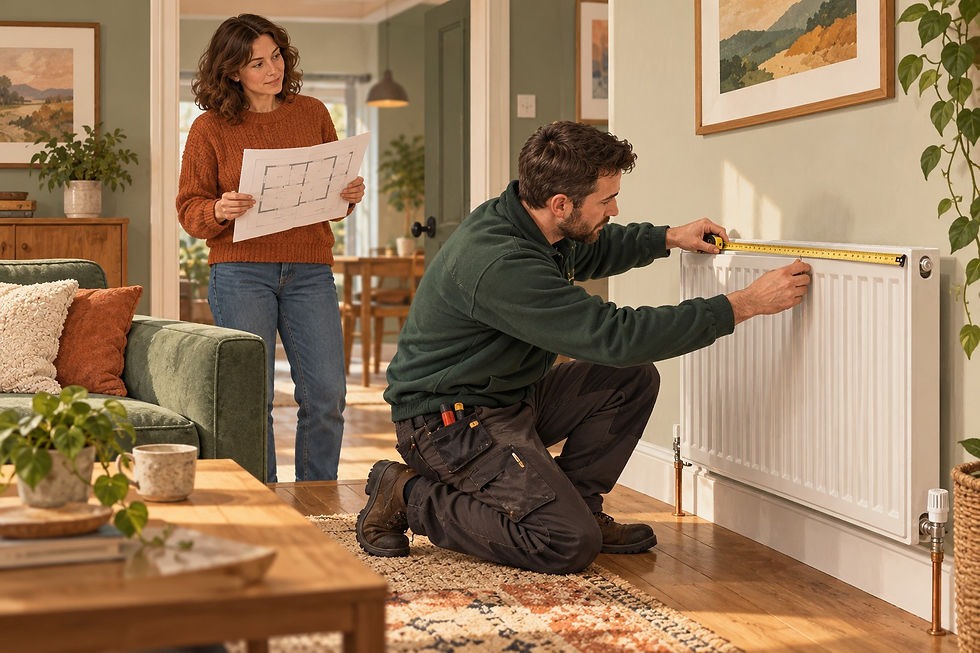
Illustration: a radiator survey helps assess possible changes, alongside room-by-room heat-loss calculations.
What makes a heat pump installation more expensive?
The amount of heat your home loses
The heating system has to replace the warmth escaping through the building. Floor area matters, but so do insulation, glazing, ventilation and the shape and exposure of the house.
Ask the installer to explain the calculated heat loss and the proposed heat pump output at the relevant cold-weather conditions. The rated capacity in a product name does not tell you its output under every combination of outdoor and water temperature.
Buying the largest unit you can afford is not a substitute for design. Ask why the proposed size suits the house, including how it operates when demand is much lower in milder weather.
Radiator upgrades
Existing radiators may be suitable, or some may need replacing. The answer should come from each room's heat demand and the radiator's output at the proposed water temperatures.
For example, a radiator rated at a relatively high boiler-water temperature will deliver less heat when supplied with cooler water. An installer may recommend a larger radiator or one with more panels to provide sufficient output without raising the temperature for the entire house.
Request a room-by-room list rather than an unexplained instruction to replace every radiator. Equally, removing necessary upgrades just to reduce the quote may leave particular rooms cold or force less efficient operation.
Hot-water storage
Moving from a combi boiler often means finding space for a cylinder or agreeing a suitable alternative hot-water arrangement. An existing cylinder is not automatically suitable: heat exchanger performance, capacity and the system design need checking.
Ask where the proposed equipment will go, whether cupboards need altering and whether the quote includes plumbing and electrical connections. A cylinder relocated far from the heat pump or bathrooms may create additional pipework and practical compromises.
Pipework and electrical provision
Existing pipes are not automatically unsuitable because they are narrow, but they must carry the required flow within an appropriate design. Ask what assessment supports any proposed replacement and how much disturbance it creates.
The electrical survey should establish the circuit requirements and whether any supply or consumer-unit work is needed. If the local electricity network operator must be involved, agree who handles that and whether any associated charges sit outside the installation price.
Access, siting and making good
A short, accessible pipe route is different from running services around a large house or through finished rooms. Restricted access may also change equipment handling and labour requirements.
Check for reinstatement costs: lifting and relaying floors, repairing plaster, decorating, rebuilding cupboards or restoring paving and landscaping. These can be genuine project costs even when they are excluded from the heating contractor's work.
For a flat or leasehold home, establish the necessary permissions before committing. Freeholder or managing-agent approval, access arrangements and communal-system constraints can affect both feasibility and cost.
How much could you pay after a grant?
The examples below are invented budgets to show how the calculation works. They are not quotations, averages for the property types or promises that these homes need the work described.
Illustrative project | Assumed installed quote | Confirmed grant assumed | Customer contribution |
|---|---|---|---|
Straightforward air-to-water installation with limited alterations | £10,000 | £7,500 | £2,500 |
Installation with cylinder work and some radiator changes | £13,000 | £7,500 | £5,500 |
More extensive conversion with substantial internal alterations | £18,000 | £7,500 | £10,500 |
Same £18,000 project, eligible oil/LPG replacement without mains gas | £18,000 | £9,000 | £9,000 |
£13,000 installation without an eligible grant | £13,000 | £0 | £13,000 |
These assumed totals cover the defined installation only. Any separate insulation, decorating or other building project would need adding. The £9,000 grant example uses the temporary rules in place at the date of checking.
What heat pump grants are available?
England and Wales
The Boiler Upgrade Scheme currently provides £7,500 for eligible air-to-water or ground-source heat pumps, including qualifying water-source systems. Until 31 March 2027, eligible properties replacing oil or LPG heating without a mains gas connection can receive £9,000. [2]
Your MCS-certified installer applies on your behalf. Agree the grant deduction, timing and your liability if funding is not approved. [7]
Ownership, the existing heating system, property and installation rules all matter. Most new-build properties and social housing are excluded; qualifying self-builds can be eligible. Grants are not generally available to replace an existing low-carbon system. Check your circumstances rather than assuming every homeowner receives funding. [2,8]
Scotland
Home Energy Scotland offers eligible homeowners grants of up to £7,500 for qualifying heat pump installations, with an uplift to £9,000 for eligible rural households. Optional interest-free loan support may also be available. [9]
A loan is repayable funding, not another grant. Check fees, approval requirements and when payments are released. Contact Home Energy Scotland before committing to work: the application and payment arrangements differ from the installer-led scheme in England and Wales.
Northern Ireland
The Boiler Upgrade Scheme does not cover Northern Ireland. Do not subtract the England-and-Wales grant from a Northern Ireland quote. Ask NI Energy Advice about current assistance and eligibility before ordering; support for other improvements should not be assumed to fund the heat pump itself. [1,7]
Could the installation be fully funded
Some eligible households may receive improvements through a separate local scheme. In England, the Warm Homes: Local Grant can fund agreed measures, including air-source heat pumps, following assessment and subject to local funding. It targets qualifying privately owned homes with EPC ratings D–G; income, benefits or postcode eligibility routes apply. [10]
That is different from an installer advertising a free installation after the standard grant. Ask precisely which scheme is involved, what is covered and whether you have any contribution to make. Do not assume two grants can be combined for the same work.
Is VAT included in heat pump prices?
Qualifying residential heat pump installations currently benefit from zero-rated VAT under the energy-saving materials rules. HMRC's published guidance says the temporary zero rate runs until 31 March 2027, with a return to 5% from 1 April 2027 under the current rules. [11]
This does not mean every unrelated building job on the same project is automatically zero-rated. The supply arrangement and nature of the work matter. Ask for the VAT-inclusive amount you will actually pay and an explanation of the treatment of separately charged works.
If a quote already includes zero-rated VAT, there is no further 20% to deduct. Buying equipment on its own also has different VAT treatment from a qualifying supply-and-install arrangement. [11]
How much does a heat pump cost to run?
Installation cost and running cost need separate calculations. The annual electricity bill depends on useful heat demand, the system's measured seasonal efficiency and the electricity prices paid when it operates.
The basic calculation is:
Annual heat pump electricity use = annual useful heat demand ÷ seasonal efficiency.
For an illustrative home needing 12,000kWh of useful heating and hot water a year, electricity at 25p/kWh produces the following results:
Assumed seasonal efficiency | Annual electricity | Annual energy cost | Monthly average |
|---|---|---|---|
2.5 | 4,800kWh | £1,200 | £100 |
3.0 | 4,000kWh | £1,000 | About £83 |
3.5 | About 3,429kWh | About £857 | About £71 |
4.0 | 3,000kWh | £750 | £62.50 |
These are our calculations, not current tariff quotations or typical household bills. They exclude standing charges, servicing and repairs. The monthly column divides the annual total by 12; winter consumption will usually be much higher than summer consumption.
Use an efficiency assumption covering the relevant heating and hot-water demand and electrical inputs, including backup heating where applicable. A manufacturer's favourable test-point COP should not be presented as guaranteed year-round performance.
On a time-of-use tariff, apply the rates to the electricity used in each period. The cheapest advertised overnight price is not the price of every unit your heat pump consumes.
Is a heat pump cheaper to run than a gas boiler?
It can be, but efficiency alone does not settle the comparison because electricity and gas have different unit prices.
For a fair example, keep useful heat demand constant. Assume the same 12,000kWh demand, gas at 6p/kWh and a boiler delivering 90% seasonal efficiency. The boiler would use about 13,333kWh of gas, costing £800 before standing charges and servicing.
At the illustrative 25p electricity rate, the heat pump examples above range from £1,200 at seasonal efficiency 2.5 to £750 at efficiency 4.0. That gives outcomes from £400 more to £50 less than the example boiler's energy cost.
The energy-cost break-even efficiency is:
Electricity unit price × boiler efficiency ÷ gas unit price.
For these assumptions, 25 × 0.90 ÷ 6 = 3.75. This is a calculation for these invented prices, not a universal efficiency target. Different tariffs change the result.
If you stop using gas entirely and end the gas supply arrangement, you may also avoid its standing charge. Do not count that saving if you retain a gas hob, fire or other gas appliance and continue paying the charge. Include any disconnection and replacement-appliance costs in the upfront comparison.
What are the servicing and ownership costs?
Energy Saving Trust suggests around £150 for a heat pump service, but prices vary. Ask for your installer's service price and what it covers. Check whether the hot-water cylinder's service requirements are included or charged separately. [3]
Read warranty conditions before deciding that one system is better value. A long parts warranty may leave labour, callouts or other components outside cover. Ask who handles faults and whether regular servicing is a condition.
A ten-year budget can be useful, provided it is labelled clearly. Using the invented £13,000 installation above, a £7,500 grant, 4,000kWh annual electricity at 25p and £150 annual servicing gives:
Ten-year budget item | Illustrative cost |
|---|---|
Initial customer contribution | £5,500 |
Electricity over ten years | £10,000 |
Servicing over ten years | £1,500 |
Total of these items | £17,000 |
This is a simple constant-price illustration. It excludes finance, repairs, replacement components, standing charges and future price changes, and assumes unchanged annual consumption. It is not a prediction of total ownership cost.
Compare the same categories for the alternative. If your boiler needs replacing now, include its replacement cost. If it is working well and would otherwise remain, do not pretend that an avoided boiler purchase is an immediate cash saving.
Will a heat pump pay for itself?
There is no reliable universal payback period. It depends on the extra upfront expenditure compared with your realistic alternative and the annual saving after allowing for relevant ongoing costs.
For example, suppose a heat pump would cost you £5,500 after funding and a boiler replacement you would otherwise buy costs £3,000. Those invented quotes give an additional upfront cost of £2,500.
If the heat pump then saves £250 a year after relevant running and servicing differences, simple payback is ten years. If it saves £100, payback is 25 years. If annual costs are higher, there is no positive running-cost payback under those assumptions.
This calculation ignores financing, future prices and equipment replacement. It also does not put a cash value on other reasons for switching. Use it to test a sales claim, not to promise a result.
How to reduce the installation cost without cutting useful work?
Get several surveyed quotes and ask each installer to explain the main cost drivers. It may be possible to simplify a pipe route, choose a different cylinder location or retain suitable existing emitters.
Ask which proposed improvements are necessary for the design, which improve efficiency and which are optional preferences. Underfloor heating, solar panels and batteries are not purchases every household must make to have a heat pump. Assess them separately rather than accepting a large package without understanding it.
If you are already renovating, coordinate the jobs. Installing pipework while floors are open may avoid later disruption. Consider sensible insulation improvements before final system sizing where possible, so the design reflects the home you intend to heat.
Avoid removing commissioning, adequate emitters, safe electrical work or required controls to reach a target price. A cheaper installation that needs remedial work or costs more to run may be poor value.
Questions to ask before accepting a quote
1. Is this the full surveyed installation price, including the listed alterations and VAT?
2. What grant have you assumed, and who pays if it is not approved?
3. What heat loss and cold-weather conditions is the design based on?
4. Which radiators and pipes need changing, and why?
5. How will the system meet our hot-water needs?
6. What predicted electricity use and tariff assumptions support the running-cost estimate?
7. What work, permissions or network charges sit outside your price?
8. What happens if rooms do not reach the agreed temperatures?
9. Who provides servicing and repairs, and what does the warranty exclude?
10. What are the payment stages, cancellation terms and protections for any deposit?
Keep the answers with the quotation. When offers differ by several thousand pounds, these details help establish whether you are comparing different designs, different scopes or simply different prices.
Frequently asked questions
How much does a heat pump cost for a three-bedroom house?
There is no dependable bedroom-based price. The approximately £12,000 air-source installation benchmark is a starting point, but heat loss, radiator suitability, hot-water provision and access determine the quote. Get a survey rather than buying a capacity from a bedroom chart.
Can I get a heat pump for free?
Some households qualify for fully funded improvements, and some installation offers may leave little or nothing to pay after funding. Neither means every homeowner gets a free heat pump. Confirm eligibility, scope and the final price in writing.
Do I have to replace every radiator?
No. Each radiator needs assessing against its room's heat demand at the proposed operating temperatures. Some may stay, others may need upgrading.
Do I need underfloor heating?
No. A heat pump can be designed to work with suitable radiators. Underfloor heating is one emitter option, not a universal installation requirement.
Does the £7,500 grant cover the whole installation?
It is a contribution towards an eligible installation, not a promise that the full project will cost £7,500. You pay any remaining agreed cost unless another permitted funding arrangement applies.
Are heat pumps cheaper in new builds?
Designing low-temperature heating and equipment space into a building can avoid some retrofit work. However, the quoted scope and grant eligibility may differ, so do not compare a new-build equipment price with an existing home's complete conversion.
Should I wait for prices to fall?
Compare the actual offers and funding available to you with the cost and condition of your current heating. Future equipment prices, tariffs and grants are uncertain. If a temporary grant applies, check its deadline without allowing sales pressure to replace a proper survey.
What is the best way to work out my budget?
Obtain a complete installation quote, subtract only confirmed funding, add excluded works and compare realistic ongoing costs. Those figures are more useful than the outdoor unit's retail price or a headline starting offer.
Sources and calculation method
[1] Energy Saving Trust, Air source heat pumps. Current opened page states approximately £12,000 installed; older indexed snippets showing £11,000 were not used. https://energysavingtrust.org.uk/advice/air-source-heat-pumps/
[2] GOV.UK, Boiler Upgrade Scheme what you can get. Grant values and temporary oil/LPG uplift. https://www.gov.uk/apply-boiler-upgrade-scheme/what-you-can-get
[3] Energy Saving Trust, Your heat pump questions answered. Approximate service cost and servicing guidance. https://energysavingtrust.org.uk/heat-pump-questions-answered/
[4] Energy Saving Trust, Ground source heat pumps. Trench installation benchmark and borehole caveat. https://energysavingtrust.org.uk/advice/ground-source-heat-pumps/
[5] R A Brown, How much does a ground source heat pump installation cost. Contractor example for a four-bedroom property with 12 radiators. https://rabrown.co.uk/faq/how-much-does-a-ground-source-heat-pump-installation-cost/
[6] Energy Saving Trust, Air-to-air heat pumps. Published single-room and three-bedroom example costs. https://energysavingtrust.org.uk/advice/air-to-air-heat-pumps/
[7] Ofgem, Boiler Upgrade Scheme property owners. Geographic scope, installer-led application and certification. https://www.ofgem.gov.uk/environmental-and-social-schemes/boiler-upgrade-scheme-bus/property-owners
[8] GOV.UK, Boiler Upgrade Scheme check if you are eligible. Ownership, exclusions and self-build provisions. https://www.gov.uk/apply-boiler-upgrade-scheme/check-if-youre-eligible
[9] Home Energy Scotland, Grant and Loan and associated terms. Grant limits, rural uplift and loan distinction. https://www.homeenergyscotland.org/home-energy-scotland-grant-loan
[10] GOV.UK, Apply for the Warm Homes Local Grant. Eligibility and council delivery. https://www.gov.uk/apply-warm-homes-local-grant
[11] HMRC, VAT Notice 708/6. Qualifying supply and installation, associated works and current zero-rate timetable. https://www.gov.uk/guidance/vat-on-energy-saving-materials-and-heating-equipment-notice-7086
[12] Energy Saving Trust installer toolkit, Weather compensation and other controls. Technical background on heating-water temperatures and system control. https://greenheattoolkit.energysavingtrust.org.uk/t/heat-pump-installers-toolkit/heat-pump-system-design/weather-compensation-and-other-controls/
[13] OpenEnergyMonitor, Heat pump monitoring. Technical background on measured heat, electricity input and efficiency. https://openenergymonitor.org/docs/applications/heatpump.html
Methodology: Published benchmarks are attributed locally. All project budgets, energy comparisons, ownership totals and payback examples are our own illustrative calculations from the stated inputs. These examples are not market research, quoted offers or predicted savings for a particular home. Small rounding differences are identified through approximate values.
More help with your installation decision
Explore our heat pump grants and offers guide, hot-water planning advice, heat pumps in flats guide and installer checklist.
Images are AI-generated editorial illustrations.


Understanding the true cost of installing a heat pump goes beyond just the unit price—factors like insulation, labor, and long-term energy savings all play a role. Homeowners should research thoroughly and compare options before deciding. For a detailed breakdown and expert tips, you can check this article by Insulation Contractors for better guidance.
This is a very informative breakdown, and it highlights an increasingly important topic in real estate: energy efficiency and sustainability in homes. As more buyers and tenants prioritise lower running costs and eco-friendly features, understanding the real cost and benefit of installations like heat pumps becomes critical. Upgrading to more efficient heating systems not only reduces utility bills for occupants but can also enhance property value and market appeal, especially in markets where energy performance ratings and environmental standards are rising. For landlords and homeowners alike, investing in energy-efficient solutions is both a smart financial decision and a step toward future-proofing properties in a competitive real estate landscape. Visit deposit protection scheme
Thanks for this helpful guide on the real cost of installing a heat pump it clearly explains how the total price includes more than just the equipment, like labour, pipework and any upgrades needed. It’s useful to know that a complete installation can range from around £10,000 to £15,000 before any government support, and that grants like the Boiler Upgrade Scheme can reduce what homeowners pay significantly. I also liked how the article highlights the importance of insulation and planning ahead to make the system more efficient and save money long‑term. For those looking to manage their properties efficiently, property asset management can also play a key role in maintaining value and optimizing costs.